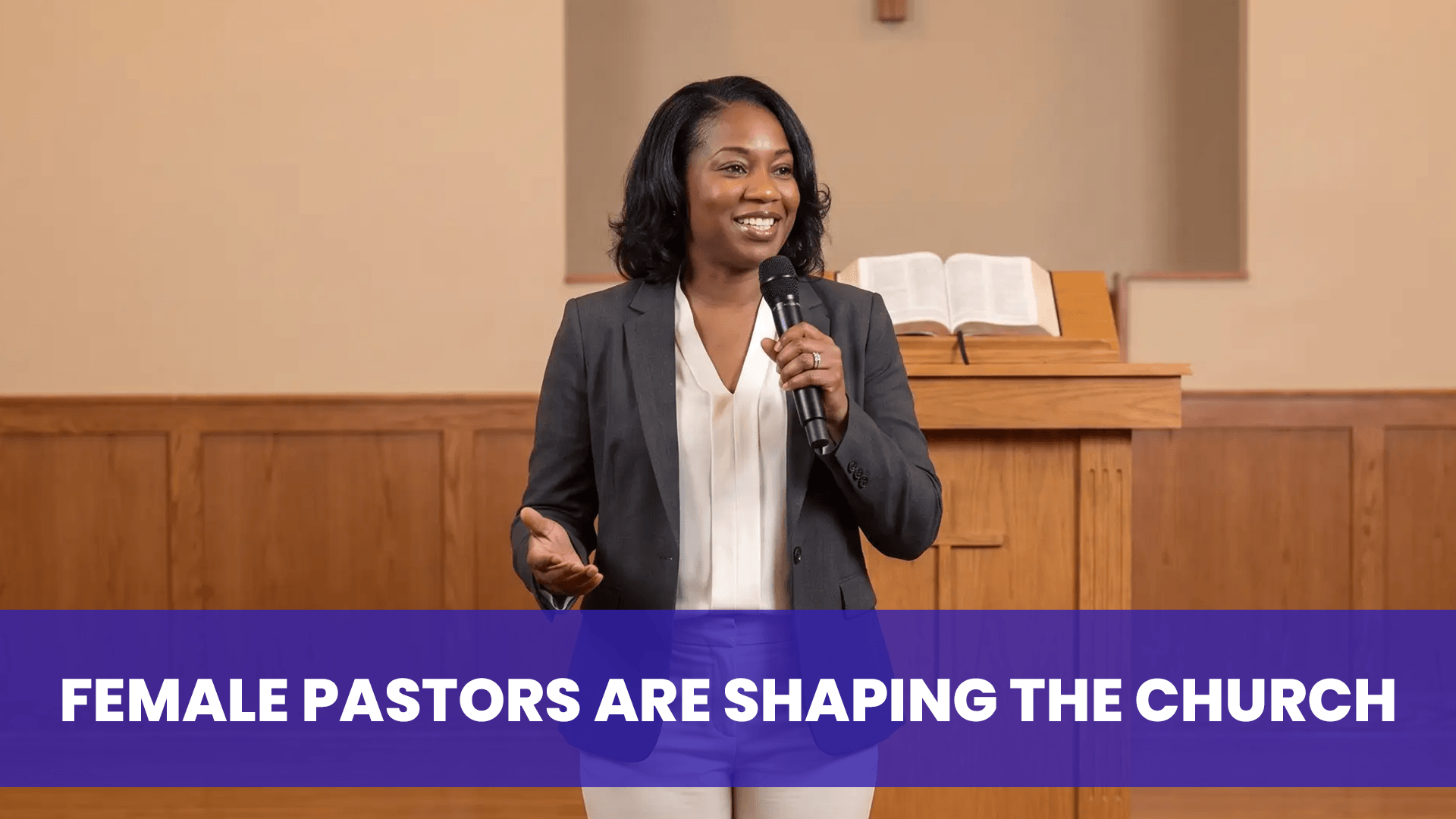
A female pastor standing at the front of a church may feel completely ordinary in one congregation and represent a major shift in tradition in another. Across Christian denominations, women’s paths into pastoral leadership remain remarkably different, shaped by theology, church culture, opportunity, and long-established expectations about who should lead.
That makes the story of female pastors in the modern church more complicated than a simple narrative of progress.
Many women are preaching, teaching, counseling, leading teams, planting churches, and caring for congregations. At the same time, others belong to Christian traditions that do not ordain women as pastors, while some women serving within denominations that permit female ordination still encounter barriers on the path to senior leadership.
Understanding how female pastors are shaping churches today means looking at both realities.
The Changing Place of the Female Pastor
Women serving churches is nothing new.
What has changed in many Christian traditions is the visibility of women in formal pastoral and senior leadership positions.
Today, female pastors serve as lead pastors, associate pastors, chaplains, church planters, ministry directors, teachers, and denominational leaders across numerous Christian traditions. In some denominations, seeing a woman preach or lead a congregation has been familiar for decades.
In others, the question remains deeply contested.
Those differences are important because Christianity does not have one universally accepted position on women serving as pastors. Churches reach different conclusions based largely on their interpretations of Scripture and their theological traditions.
Research illustrates just how wide that denominational gap can be. In a Lifeway Research study, 76% of mainline Protestant pastors said women could serve as senior pastors in their churches, compared with 44% of evangelical pastors.
So there is no single experience of being a female pastor.
A woman may enter ministry in a denomination with a well-established path to ordination or find herself navigating a church culture where female pastoral leadership is relatively unfamiliar.
Female Pastors Are Expanding the Picture of Church Leadership
One of the clearest ways female pastors are shaping modern churches is simply through visibility.
Leadership influences what people imagine is possible.
When women occupy pastoral positions, girls and younger women within those church traditions can see ministry leadership as something they might pursue themselves. Congregations also become accustomed to seeing pastoral authority expressed through leaders with different personalities, backgrounds, experiences, and perspectives.
That does not mean women inherently possess one leadership style while men possess another.
Female pastors are not a single type of leader.
Some are gifted preachers. Others excel at counseling, organizational leadership, discipleship, teaching, community outreach, or developing teams. Some lead quietly; others have commanding public personalities.
Their significance lies partly in demonstrating that pastoral leadership itself can take many forms.
The Work of Pastoral Ministry Remains the Work of Pastoral Ministry
Discussions about women in ministry sometimes focus so heavily on gender that the actual work of being a pastor disappears from view.
A female pastor still has sermons to prepare, people to counsel, difficult conversations to navigate, leaders to develop, volunteers to support, and a congregation to serve.
The work pastors carry throughout church life can stretch from preaching and spiritual care to leadership and administration, regardless of whether the person carrying those responsibilities is a woman or a man.
That reality is important.
Female pastoral leadership is not only about women gaining access to a title. It is about women taking responsibility for the ordinary, demanding, deeply relational work that comes with serving a congregation.
What Barriers Do Female Pastors Still Face?
Greater visibility does not mean every barrier has disappeared.
Research into Protestant congregations continues to identify obstacles affecting women’s access to senior pastoral positions. A 2025 study examining barriers to the pulpit noted persistent gender disparities in church leadership and clergy compensation, while previous research has identified theological, cultural, historical, and institutional barriers affecting women clergy.
Those barriers do not appear equally everywhere.
Access to Senior Leadership
A denomination may permit women to become pastors without women necessarily having equal access to every pastoral position.
Research published in 2024 using data on Protestant churches found that larger congregations were less likely to have a female pastor, suggesting that opportunities can narrow as the size (and often prominence) of the leadership position increases.
This creates an important distinction between permission to lead and opportunity to lead.
A church or denomination can formally support female pastors while informal expectations, hiring patterns, or congregational preferences still influence which positions women are realistically considered for.
Different Expectations of Leadership
Women in pastoral ministry can also encounter expectations that their male colleagues experience differently.
Earlier Barna research found female senior pastors were more likely than male senior pastors to report feeling unprepared for expectations of perfection or the sense that they needed to do everything themselves.
That pressure can create a difficult leadership environment.
A female pastor who is one of relatively few women in senior leadership within her tradition may feel that her mistakes are interpreted as more than individual mistakes. Success can feel representative; failure can feel representative too.
No pastor should have to carry an entire gender into every leadership decision.
Finding Mentors and Leadership Networks
Mentorship matters in ministry.
Pastors benefit from experienced leaders who can help them navigate conflict, staffing decisions, preaching, pastoral care, boundaries, and the emotional weight of serving a congregation.
For women entering leadership environments historically dominated by men, finding mentors who understand some of their specific experiences can be more difficult.
That is one reason healthy leadership pipelines matter.
Churches that ordain women need more than permission on paper. Developing future leaders also requires opportunities to preach, lead teams, receive mentoring, make meaningful decisions, and gain the experience necessary for greater responsibility.
Female Pastors and the Question of Representation
Representation is sometimes discussed as though its only purpose is making an organization appear more diverse.
In a church, its effects can be more personal.
Consider a young woman who has spent years serving in ministry and senses a calling to pastoral leadership. Seeing women already carrying significant ministry responsibilities can make the path ahead easier to understand.
She can observe not simply that a woman can become a pastor, but what the life of a female pastor actually involves.
She can see someone preparing sermons, leading meetings, handling criticism, supporting families, navigating difficult decisions, and continuing to grow as a leader.
Representation becomes practical rather than symbolic.
It provides an example from which another generation can learn.
How Female Pastors Can Broaden a Church’s Perspective
Different life experiences can also bring different questions into leadership conversations.
That does not mean every female pastor thinks alike or that women automatically understand every woman in their congregation.
They do not.
But leadership teams benefit when important decisions are shaped by people who do not all share identical experiences.
A female pastor may notice a concern that another leader has overlooked. A male pastor may recognize something she has missed. Leaders from different generations, cultures, socioeconomic backgrounds, and family situations can do the same.
The benefit comes not from assuming that one person speaks for an entire demographic, but from creating leadership environments where different perspectives can challenge blind spots.
Healthy diversity should deepen conversation rather than reduce people to categories.
The Theological Debate Has Not Disappeared
Any serious discussion of female pastors needs to acknowledge an important reality: Christians disagree about whether women should hold the office of pastor.
Those disagreements are rooted in differing interpretations of Scripture rather than simply resistance to social change.
Churches commonly described as complementarian generally understand certain pastoral or elder roles as reserved for qualified men, although their views on other ministry leadership positions for women can vary.
Churches with an egalitarian understanding generally believe pastoral offices are open to qualified women and men.
Those theological differences continue to shape denominational policies and local church practices.
Recognizing the disagreement does not require this article to resolve it.
What matters when examining female pastors in modern churches is understanding that women are leading within traditions that affirm their pastoral calling while other Christian traditions maintain different convictions about the pastoral office.
That context helps explain why the experience of female pastors can vary so dramatically from one church to another.
What Churches Can Learn From Female Pastoral Leadership
For churches that ordain women, the next question is increasingly not simply whether women are allowed to lead.
It is whether churches have created environments in which qualified leaders can actually flourish.
That means looking at practical questions.
Are emerging leaders receiving meaningful opportunities to develop? Are expectations applied consistently? Can female pastors access mentorship? Are hiring and compensation decisions fair? Do leadership teams listen to different perspectives without expecting one woman to represent all women?
These are organizational questions, but they ultimately affect ministry.
Barna reported in 2024 that only 32% of female pastors surveyed said they were “very satisfied” with their ministry at their current church, compared with 49% of male pastors. That gap suggests that opening leadership positions alone does not answer every question about the experience of women once they enter them.
Churches need to think about both opportunity and sustainability.
Beyond Breaking the Barrier
There is something slightly paradoxical about discussing the rise of the female pastor.
Every first matters.
The first woman to preach regularly in a congregation, join a pastoral team, or become its senior pastor can challenge expectations simply by being there.
But lasting change occurs when her presence eventually stops being remarkable.
She becomes known not primarily as the female pastor, but as the pastor who sat beside a family during a crisis. The pastor whose sermon someone remembers years later. The leader who developed younger ministers. The person who helped a congregation navigate a difficult season.
That may ultimately be one of the most significant ways female pastors are shaping modern churches.
They are expanding the visible picture of pastoral leadership while doing the same difficult, human work pastors have always done: teaching, leading, listening, caring, and serving the communities entrusted to them.