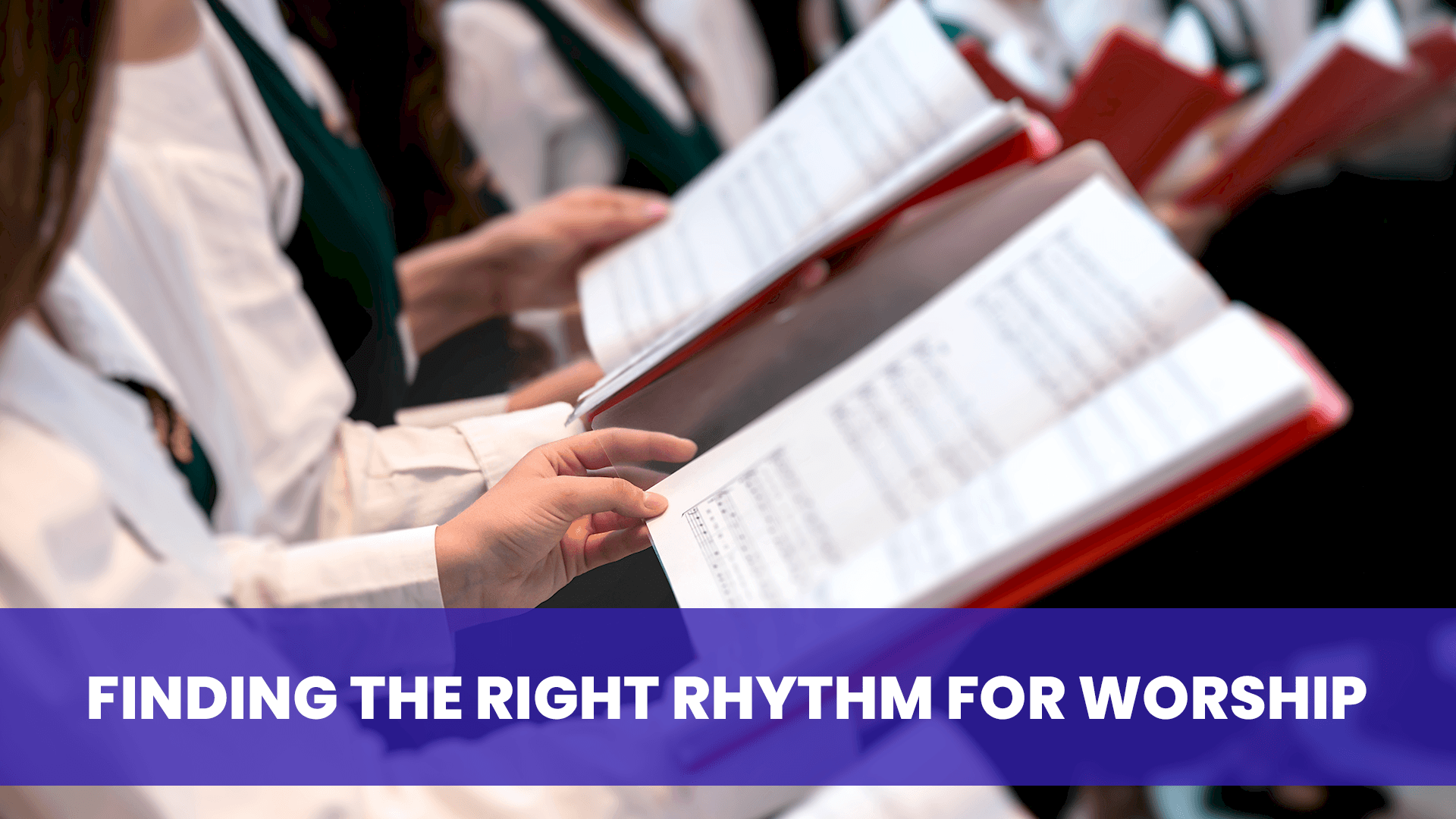
Most lists of upbeat worship songs stop at the titles. They’ll tell you what’s popular this year, maybe a line about why, but skip the harder questions a worship leader actually has to answer: how many fast songs belong in a set, where they should go, and how to introduce a new one without losing the room halfway through.
This guide covers both: a working list of upbeat worship songs, and the decisions around how to actually use them.
What Actually Makes a Song “Upbeat”?
It starts with tempo, but that’s not the whole story. Songs in the 120-140 BPM range with a driving rhythm section read as upbeat almost automatically. Below that range, energy comes more from dynamics than speed: a moderate-tempo song can still feel upbeat if it builds, or if the drums come in hard on the chorus, or if the melody sits high enough that people naturally raise their volume to hit it.
That’s why some songs that aren’t technically fast, like driving anthems built around a big chorus, still get grouped with upbeat worship songs. When you’re building a set, it helps to think in terms of felt energy rather than metronome speed alone.
How Many Upbeat Songs Belong in a Worship Set?
There’s no fixed formula, but most sets that work well land somewhere between one-third and half of their songs on the faster end, rather than tilting the whole set one direction. A common shape is two upbeat songs to open and build energy, one song that shifts the room into a more reflective posture, and a closing song that can go either way depending on what the message called for.
A set that’s entirely upbeat can start to feel like a concert rather than a service. One that’s entirely slow tends to lose momentum before the sermon even starts. The exact ratio matters less than making sure the set has a shape, a rise and a settle, rather than sitting at one energy level the whole time.
Where Upbeat Songs Work Best in the Service
Placement changes what a song does. As an opener, a fast song gets people out of the parking-lot mindset and into the room. There’s no expectation to manage yet, so an immediate hook gives people something to do with their hands and voice before they’ve settled into staying quiet.
Mid-set, an upbeat song after two slower ones acts as a reset. It pulls the room back from a purely internal posture into something more communal, especially right before a transition like announcements or the offering.
As a closer, an upbeat song works best when the message was about hope, victory, or celebration. A high-energy closer after a heavy or convicting message can feel tonally off, so this slot depends more on the sermon than the other two.
Upbeat Worship Songs Worth Knowing Right Now
A rotation that pulls from a few different categories tends to hold up better over time than one built around a single style.
Songs to open a service
- “Worship!” – TAYA: an immediate hook rather than a slow build, good for pulling attention right from the first note.
- “10,000 Armies” – Influence Music: high-energy from the start, works well for a room that’s still filing in.
- “Move Of God” – SEU Worship: simple and repeatable, easy for a congregation to pick up on the first pass.
- “Yes He Lives” – Hannah Hobbs & Alexander Pappas: a clear resurrection theme, good for a celebratory opener.
For celebration and declaration
- Psalm 103 adaptation (“Bless the Lord, O My Soul”) – Matt Redman: high energy while staying tightly rooted in scripture.
- “House Of The Lord” – Phil Wickham: built for a room that’s already engaged and ready to respond.
- “Glory, Glory (God Is Able)”: centered on God’s power, gives the congregation something to shout rather than just sing.
- “New Name Written Down In Glory”: a jubilant, declarative feel suited to moments of testimony.
Modern arrangements of older hymns
- “How Great Thou Art” – Paul Baloche’s version: familiar words for longtime members, a sound that still feels current.
- “Victory in Jesus” – Travis Cottrell’s version: bridges generations without losing the hymn’s original weight.
- “Joyful (The One Who Saves)” – Brenton Brown: upbeat feel paired with real theological depth, not just repetition.
Balancing Energy for a Multigenerational Congregation
The tension most churches run into isn’t finding upbeat songs. It’s finding ones that land across a room with very different musical backgrounds.
Longtime members raised on hymns sometimes read heavy modern production as more performance than worship. Newer or younger attendees, on the other hand, can find a slow, sparse arrangement disengaging.
Splitting the difference usually works better than picking a side. A fast arrangement of a hymn people already know does more bridging work than either an unfamiliar contemporary song or an unfamiliar hymn, because the words are already familiar even if the sound is new. Watching which songs get visible participation, not just applause, is a better read on this than assuming energy alone will work for everyone.
Introducing a New Upbeat Song Without Losing the Room
New songs are where good upbeat music quietly fails, not because the song is weak, but because the congregation doesn’t know it yet and a fast tempo leaves no time to catch up. Playing a new song as a bed under announcements or a video the week before gives people passive exposure before they’re expected to sing. Repeating the chorus more than the recording does the first few times you play it gives newcomers a chance to pick it up mid-song rather than only by the second verse.
It also helps to pair a new upbeat song with a familiar one in the same set, rather than introducing two unfamiliar songs back to back. That keeps the room from feeling like it’s being tested rather than led.
Keeping a Rotation From Going Stale
Repetition is part of how congregational singing works, so some overlap week to week is a feature, not a problem. It becomes a problem when the same handful of songs get recycled simply because nobody’s tracking what’s already been played.
Keeping even a simple record of recent setlists makes it obvious which upbeat worship songs are due for a rest and which ones have earned a longer run because the room keeps responding to them.
Worship leaders who ask their team which songs feel tired, rather than relying on their own instinct alone, tend to catch fatigue earlier than the congregation would ever say out loud.
It’s a small habit, but it sits in the same category as most of the other things that make a church run smoothly week to week, the kind of ongoing organization that’s a lot easier when the different parts of running a church live in one connected place instead of scattered across separate tools.